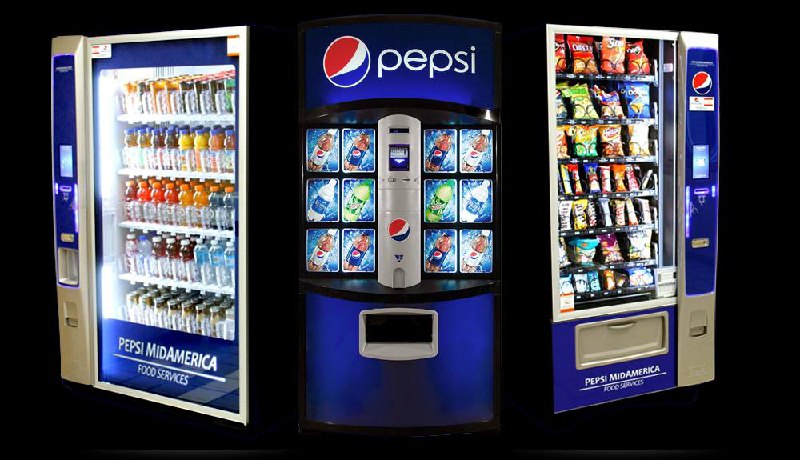
If you have been pricing vending machines for your office or facility, you have probably noticed that the search results keep pointing you toward equipment listings, lease calculators, and articles weighing the merits of buying new versus refurbished. That framing is useful if you intend to own a vending machine. For a business that simply wants snacks and drinks available for its team, it is the wrong question entirely.
The real answer is harder to believe at first: for a qualifying business, the cost of vending machines is $0. No purchase price. No lease payments. No service contract. No monthly minimum. Most office managers we talk with assume there has to be a catch somewhere — a setup fee, a usage commitment, a hidden line item. There isn't. Felco Vending has placed equipment in Chicago and the Western Suburbs since 1986 under exactly this model.
This article explains the economics, what "free" actually covers, what a location needs to qualify, and how this compares to the lease-or-buy frame most readers arrive with.
How the Economics Actually Work
The full-service vending model is simpler than it looks. The vending operator owns the machine. The vending operator buys the inventory, delivers it, restocks it, and services the equipment. Revenue comes from product sales — the dollar your employee puts in to buy a Coke or a granola bar. That is the only money that changes hands related to the machine itself.
The business hosting the machine pays nothing. In some larger placements, the operator may even pay a commission back to the host. Either way, no money flows from the business toward the vending company. Our incentive structure is built around making sure the machines stock products people actually want, run reliably, and stay full — because that is how the model funds itself.
This is why national consumer-finance articles on "vending machine cost" feel disconnected from B2B reality. Those articles are written for entrepreneurs who want to own a route. If you are an office manager or facilities director sourcing an amenity for your team, you are on the host side of the transaction, not the operator side.
What "Free" Actually Includes
When we describe service as free, here is the complete list of what is covered at no cost to your business:
- Equipment: Modern snack vending, beverage vending, and fresh food vending machines, plus office coffee service equipment where it makes sense.
- Delivery and installation: Our team handles transport, placement, leveling, and electrical connection.
- Initial fill: Machines arrive fully stocked with a balanced product mix.
- Restocking visits: Scheduled based on consumption, not a fixed calendar — we come more often when you need it.
- Repairs and parts: If a coil hangs, a compressor fails, or a coin mech jams, we own that problem.
- Cleaning and maintenance: Exterior wipe-downs, interior cleaning, and preventive service.
- Product changes: Sales data drives rotation. If something is not moving, we swap it out.
- Direct support: A real phone number that rings in Carol Stream — not a national call center.
What the business provides is short: floor space, a 110V outlet (220V for larger combo or coffee units), and reasonable building access for our drivers during business hours.
Location Qualifications: Foot Traffic, Space, Access
The free model only works when machines generate enough sales to sustain themselves, so qualification is honest and specific. The three filters we apply are foot traffic, physical space, and access.
Foot traffic. The general benchmark is a consistent 40 or more people on site daily, though the right number depends on the type of facility. A warehouse vending placement with three shifts will outperform a 60-person law firm where everyone steps out for lunch. Manufacturing floors, distribution centers, and 24/7 operations are particularly strong candidates.
Physical space. A standard snack machine occupies roughly 39 inches wide by 35 inches deep. Beverage and combo machines vary. Break rooms, lobby-adjacent corridors, and dedicated vending alcoves all work. What does not work: outdoor placements, areas exposed to extreme temperature swings, or footprints that block egress.
Access. Our route drivers need to roll product carts in and out. That means an accessible loading dock or a ground-floor entry path, plus reasonable security clearance. We can work with badge-in buildings and visitor protocols — we just need to know up front so we can plan around it.
Geographically, we cover service areas across Chicago and the Western Suburbs from our Carol Stream base. If a location falls outside that radius, we will say so rather than commit to service we cannot reliably deliver.
How This Compares to "Lease vs Buy"
If you started this search expecting a lease-vs-buy decision, or comparing vending machine rental against ownership, here is the honest comparison.
Buying a vending machine means a capital outlay of roughly $3,000 to $10,000 per machine for new equipment, plus the ongoing operational burden: sourcing product, restocking on a schedule, handling cash and card processing, maintaining the equipment, and replacing it when it ages out. This makes sense if you intend to run a vending business. It rarely makes sense for a business that just wants snacks for staff.
Leasing a vending machine spreads the capital cost over a term, typically 3 to 5 years, but you still own the operational headaches. You are responsible for stocking, service, and the unprofitable hours of running a small in-house concession.
Full-service free placement removes both the capital question and the operational burden. The trade-off, to be transparent, is that the operator (us) sets the menu in collaboration with you and earns the product margin. For nearly every host business, that trade is plainly favorable: you get the amenity, none of the work, and none of the cost.
ROI from the Host Business's Perspective
Because there is no capital outlay, the return calculation is unusual. There is nothing to amortize. The benefits are soft but real.
Time stays on site. Employees who would otherwise drive five or ten minutes to a convenience store for an afternoon snack stay in the building. Across a workforce, that adds up.
Retention and recruiting get a small but visible lift. Walk-throughs and interviews notice the break room. Candidates compare amenities. Free, well-stocked vending is a low-cost signal that the company cares about day-to-day quality of life.
Operational coverage improves for shift work. For office vending the value is convenience; for warehouse vending, third-shift access to food and caffeine is genuinely useful and not always available from nearby retail.
And nothing hits the balance sheet. No asset to depreciate, no contract to disclose, no procurement cycle to manage.
What to Expect from Free Service vs Paid Service
A fair question: does a free model deliver service comparable to a paid contract? In our experience, it should — and often delivers better. Paid vending contracts can drift, because the operator gets paid whether the machine is full or not. Free placement is the opposite: if we do not keep your machine functional and stocked, we do not earn anything. The accountability is built into the model.
What free service does require is honest qualification up front. Placing a machine in a location that cannot sustain it helps no one. We would rather decline the placement than install equipment that will sit empty.
Getting Started
If you are weighing vending for your facility, the simplest next step is a five-minute conversation. Call (630) 871-0005 or use the contact form and tell us the location type, approximate headcount, and what your team would most want stocked. We will tell you honestly whether the location qualifies and what configuration makes sense. There is no obligation and no follow-up pressure if it is not the right fit.
The real cost of vending machines for your business, when sourced through a full-service local operator, is zero. That is not a marketing trick — it is how the industry economics work when the route, the product mix, and the location are all aligned.